
How D.C. Became a PreK Leader
and what we can learn from it

A version of this post originally appeared on the Capital Commonsense substack, where I’m an occasional contributor on D.C. education topics. If you’re a D.C. resident or involved in D.C. policies and politics, please consider subscribing.
This piece focuses on D.C.’s high rate of access to and participation in publicly funded preK and how D.C. accomplished this, but doesn’t go in depth on the quality or outcomes of preK in D.C., which I’ll address in a future post.
Next week my son will join 6,000 D.C. 3-year-olds beginning their public education journey. Over 90% of D.C. 4-year-olds, and 80% of 3-year-olds, attend publicly funded preK—twenty percentage points higher than the state with the next highest public preK participation. Nationally, only 46% of 4-year-olds and 17% of 3-year-olds attend some form of publicly funded preK, and only 11 other states serve more than half of 4-year-olds in preK. Much vaunted “Pre-K for All” programs in New York, San Antonio, and other cities also have not yet achieved the same universality as D.C., particularly for 3-year-olds.
How did D.C. come to be such an outlier in providing free public preK? How does D.C. deliver and fund public preK? And what are the implications and results for children and families? This post explores these questions.
How D.C. became a preK outlier
The history of public preK in D.C. dates back to the 1960s, when D.C. was an early pilot site for the federal Head Start program, and DCPS schools included locally funded preK classrooms. By the 2001-02 school year, preK was available in all DCPS elementary schools and reached nearly 4,300 children (44% of 4-year-olds at the time). At that point, D.C.’s charter sector was only five years old and still nascent, so its role delivering preK was small—but that would change quickly.
The passage of D.C.’s charter school law in 1996 necessitated the creation of a school funding formula (called the Uniform Per Student Funding Formula, or UPSFF) to distribute public funds between DCPS and charter schools. Because DCPS already enrolled a significant number of preK students, preK was included in the UPSFF. As a result, charter leaders recognized that they could also enroll preK students and receive UPSFF funds. In 2004, Appletree Early Learning Public Charter School (whose board I served on from 2006-2009 and recently rejoined as a parent member) received a charter to operate a school specifically focused on preK students, and most charter elementary schools would eventually include preK in their grade offerings, growing the supply of public preK in charter schools. At the same time, DCPS, facing decreasing enrollment due to competition from charter schools, expanded preK offerings as part of a strategy to attract parents, which it was able to do in part because enrollment declines had created excess space in many schools.
The growth of preK in DCPS and charter schools posed a challenge for D.C. child care operators. Child care providers in the U.S. typically rely on surpluses generated from preschool-aged care to offset the higher operating costs (and often operating losses) they incur to serve infants and toddlers. As preschoolers left child care for free preK in public and charter schools, however, this model was no longer sustainable. Concerned about the impacts on both child care businesses and supply of care for infants and toddlers, D.C. early childhood advocates pushed for a way for child care programs to also offer publicly funded preK, which they achieved in 2008 with the passage of the PreK Enhancement and Expansion Act. That legislation created a program, now known as the PreK Enhancement and Expansion Program (PKEEP), through which child care programs can apply to the Office of the State Superintendent of Education (OSSE) to be recognized as meeting preK requirements and, if approved, receive public funding to serve preK students.
The intent of PKEEP is that participating child care programs deliver preK that is equal in quality to and funded at the same levels as prek provided by DCPS and charter schools, though there have been complications in how this works in practice. DCPS and charter schools receive per-student funding through the UPSFF, just as they do for students in grades K-12. PKEEP programs, however, receive funds in the form of a grant from OSSE, which complements funds they receive from the child care subsidy program to match the UPSFF per-child funding level. Funding for the grant program does not increase automatically when the UPSFF increases, however. As both PKEEP enrollment and the UPSFF rose in the 2010s, this created a structural deficit in the PKEEP program, which has required OSSE to cap the program’s enrollment. And recent budget cycles have included proposals to cut the program’s funding and enrollment, in response to other D.C. budget pressures.
D.C.’s current preK landscape
As a result of this history, D.C. now offers publicly funded preK through a “mixed delivery” system that includes DCPS, charter schools, and community based child care facilities. Currently, charter schools account for the plurality of preK enrollment, followed by DCPS, with community-based child care programs constituting a much lower share.
DC Publicly Funded PreK Enrollment by Sector and Grade (2025-26)

OSSE, 2025-26 school year enrollment audit report data
*Reflects data from school year 2024-25, OSSE Fiscal Year 2024 PreK Report
Following the passages of the 2008 legislation, the supply of preK slots and number of children served across all three sectors grew, peaking at 13,791 students in school year 2019-20, fell precipitously during the pandemic, and remains below pre-COVID levels. Trends in preK enrollment track demographic trends—the number of annual births in D.C. has been falling since 2016—but also reflect fluctuation in the percentage of 3-year-olds enrolled in preK.
DC Publicly Funded PreK Enrollment by Sector and Year (2011-2026)
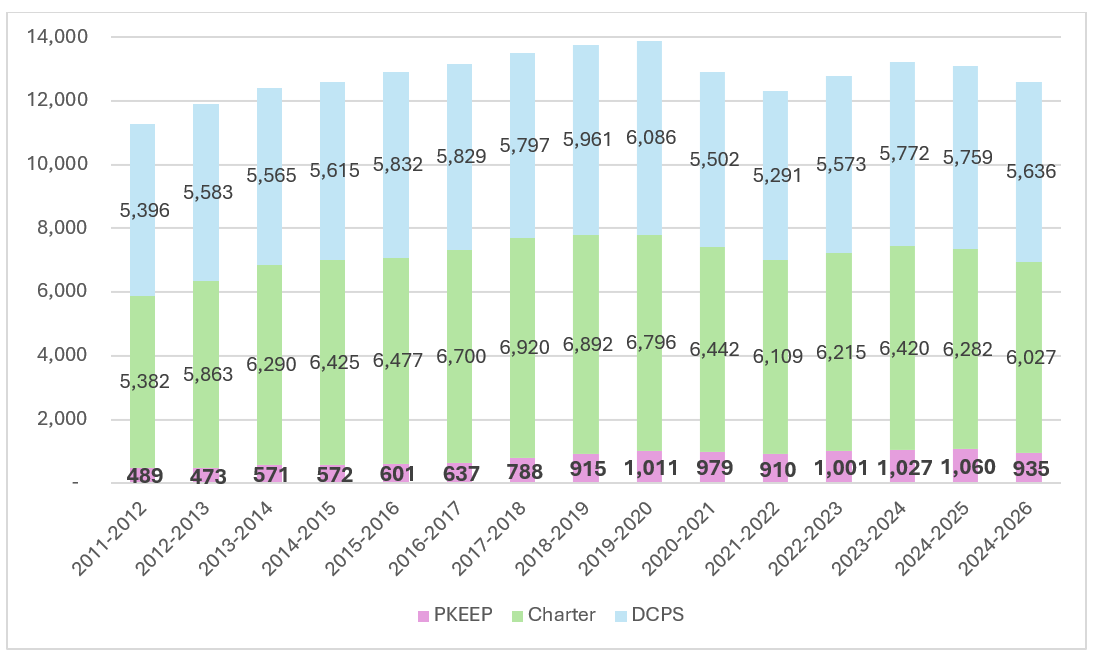
Sources: OSSE Fiscal Year 2024 PreK Report, OSSE 2024-2025 school year enrollment data report, OSSE 2025-26 school year enrollment audit report data
Navigating preK choice in D.C.
PreK students, unlike those in grades K-12, do not have a guaranteed slot at their neighborhood DCPS school of right, meaning that families wishing to enroll a child in preK at a DCPS or charter school must apply through the MySchoolDC lottery process, and children can be waitlisted for preK at their zoned DCPS school.
Districtwide, D.C. had capacity to serve 14,513 preK students across all three sectors in school year 2023-24, or enough seats to serve over 97 percent of the 14,910 children ages 3 and 4 who lived in D.C. that year. Because preK enrollment is voluntary (mandatory school attendance in D.C. starts at age 5), less than 97 percent of age-eligible children attend preK. This means that, city-wide, the District has more preK seats than it needs to serve all children whose families wish to enroll; in school year 2023-24 only 91% of public preK seats were utilized across all three sectors. But citywide trends don’t provide a full picture. Some popular DCPS and charter schools have long waiting lists for preK, while others are underenrolled, as are some PKEEP programs. Families who are committed to finding a slot in a free preK program in DC can definitely do so, but, depending on where they live, it may not be in their neighborhood.
Unlike DCPS and charter schools, child care centers participating in PKEEP do not enroll children through the MySchoolDC lottery, but each enrolls students through its own process, subject to oversight by OSSE. This is intentional, because one of the purposes of the PKEEP program is to support continuity for children and financial viability of child care businesses by enabling children who attended a child care center as infants and toddlers to remain in the same program through preK.
Learning from D.C.’s universal preK experience
D.C. achieved the nation’s most expansive free public preK program through a combination of policy, supply, and demand factors, as well as chance. That pathway has had both pros and cons, all of which merit further reflection.
In terms of policy choices, the decision to implement preK in DCPS starting in the 1960s, the enactment and design of D.C.’s charter law, the decision to include preK in the UPSFF, and the passage of the 2008 Pre-K Act all played a role. One key lesson is that including preK in the state school funding formula, as D.C. does for DCPS and charter schools, builds political support and offers a much more scalable and sustainable approach to funding universal access than funding preK through a separate grant line that can only be increased through the annual budget process (as evidenced by the history of PKEEP funding battles in recent budget cycles).
Other states and cities that have enacted policies to provide universal preK have struggled to build the supply of preK slots needed to realize that promise. In D.C., a number of factors contributed to build a supply of preK slots adequate to serve virtually all eligible children, including: the inclusion of preK slots in newly created charter schools as the sector grew, the competitive response from DCPS, and the opportunity for child care facilities to offer publicly funded preK, which they wanted to do in order to maintain viable businesses. One key lesson here is that, in a choice-based system like D.C. public education (or the U.S. child care market) competition for student enrollment (and the money that accompanies it) is a powerful driver of school and child care program behavior.
But D.C.’s high rate of public preK enrollment also reflects family demand. Other jurisdictions with expansive preK policies and robust supply, such as Vermont, New York City, and some of New Jersey’s Abbot districts, have lower rates of preK enrollment because their take-up rates are lower than D.C.’s. This is partly a reflection of demographics. D.C. has a relatively high share of both two-income professional families and working single parents, two groups particularly interested in free preK. D.C.’s high cost of child care also contributes to high take-up rates, as does our choice-based K-12 school system. Families that want to enroll their children in popular charter or DCPS district-wide options know they have the best shot at winning a lottery slot in the school’s entry grade—which for most elementary schools is preK. Moreover, the established history of public preK in D.C. and high participation rates have their own momentum: Many D.C. families just assume their child will start school at age 3. Advocates in other states often assume that parents will prefer preK in community-based child care to preK in schools, because of the longer hours offered or convenience of shared pick-ups with younger children. D.C.’s experience suggests that’s not always the case, as enrollment data suggests parents often opt for school-based programs with a clear feeder pattern through desirable elementary and middle schools over child care programs. This is helped by the fact that D.C.’s robust school choice market and competition for students pushes schools to ensure that before- and after-care arrangements (subsidized for low-income students and parent paid for other families) are available in most elementary schools.
There’s also an element of chance and contingency here. D.C. did not become a national preK leader because a single leader or group of leaders sat down, drafted a plan, and meticulously implement it over multiple years to reach universal preK. Instead, a variety of actors (DCPS leadership, charter school founders, early childhood advocates, the D.C. Council) took different actions at specific points in time, in response to their own incentives, priorities, and opportunities they saw, and those actions resulted in and shaped universal preK in D.C.
This decentralized approach has both pros and cons: it resulted in robust public preK supply, but a smaller role for community-based child care in D.C. preK delivery than many child care operators or advocates would like. And that has in turn negatively impacted child care supply and increased costs of care for infants and toddlers. But decentralized leadership and systems in which no one actor is truly “in charge” can also have benefits, because independent actors responding to opportunities and demand in a competitive marketplace can arrive at solutions that wouldn’t have occurred to a centralized planner. Early childhood systems leaders need to carefully consider that balance as they work to build early learning systems that increase equity and coherence for children and families, while maintaining a role for choice, innovation, and inclusion of a diversity of providers across the school district, charter school, and community-based, for-profit, and home child care provider sectors.
Fascinating analysis. The one issue I have with PKEEP as an advocate is that I'd rather support public institutions rather than private ones, and families can use PKEEP as a means of opting out of their neighborhood schools (and integration). Granted, there probably aren't that many, but still. I'd also love to see more public options for birth through age 2.